Equities
Index Impact: Which Stocks Are Moving the S&P 500, Nasdaq 100 and Dow, in Basis Points
Every constituent's weight times its move, summed into index basis points and points for the S&P 500, Nasdaq 100, Dow 30 and Mag 7, with the top five adding and taking away and a scenario editor.
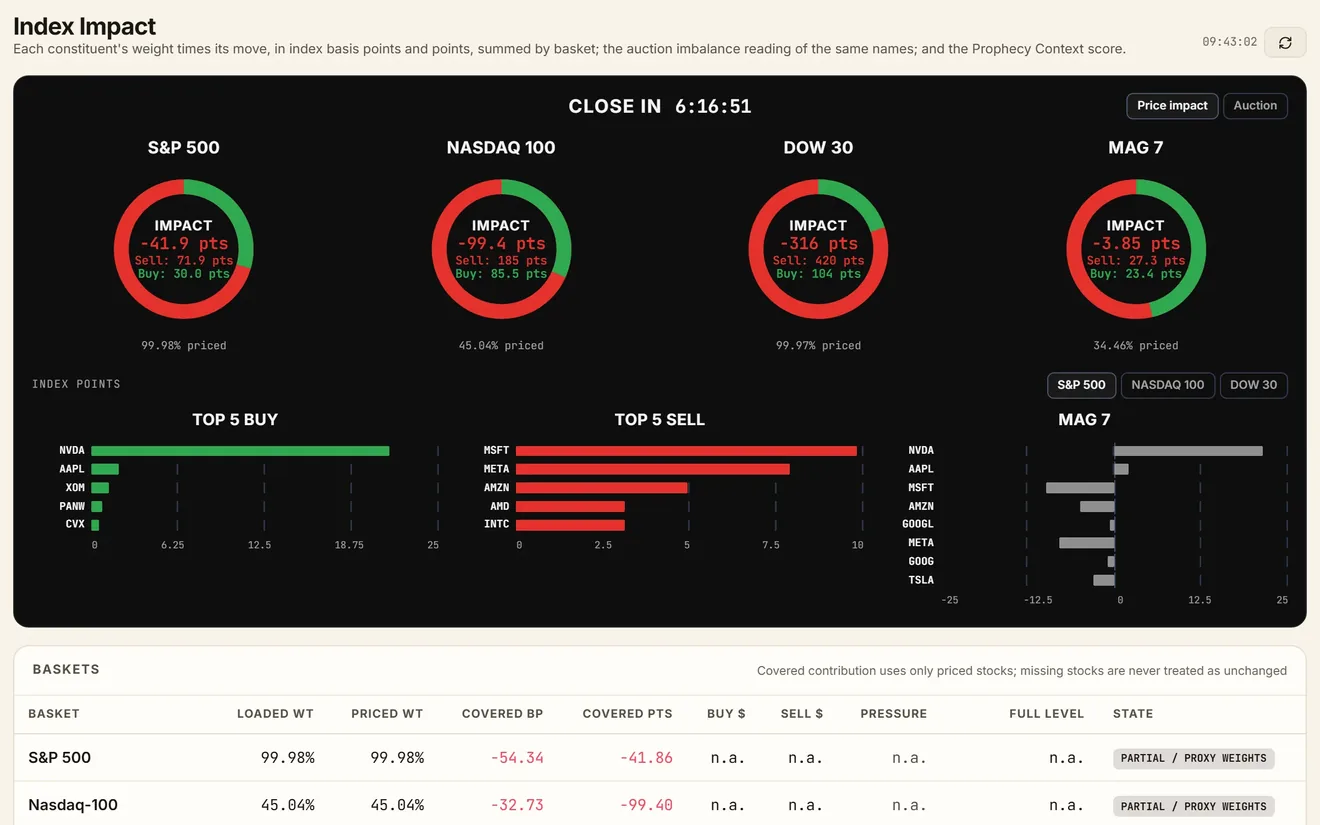
Index Impact works the arithmetic of a cap-weighted index live. For the S&P 500, the Nasdaq 100, the Dow 30 and the seven largest technology companies as a basket, every constituent's weight is multiplied by its move and the results are summed into basis points and index points, so the question of who is moving the index has a numerical answer rather than a guess from the headlines.
The opening board counts down to the New York open with a ring per index showing its implied move, and lists the five names adding most to each index and the five taking most away. Every basket shows its covered weight, the share of its members that have a price, so a missing quote is never counted as an unchanged stock.
A scenario editor gives any name a hypothetical move and shows what it does to each index, which is the tool for an earnings night: if the largest member opens down eight percent, how many points does that cost before anything else trades? A context panel scores the macro backdrop from −100 to +100 across nine families, filled in automatically from the desk's own reads.
What it shows
- S&P 500, Nasdaq 100, Dow 30 and Mag 7 baskets, in basis points and points
- The top five names adding to and taking from each index
- Covered weight shown on every basket
- A scenario editor: give any name a move and watch the index respond
- An opening board with a countdown to the New York open
Guides that explain it
Market structure
Index points and weighting
How cap-weighted indices work, how a stock's weight times its move becomes basis points and index points, and the Nasdaq 100 and Dow exceptions.
3 min read
Market structure
Market breadth
How many stocks share in an index move: the advance-decline line, the percent above the 200-day average, breadth thrusts and divergences.
3 min read
Market structure
Pre-market and after-hours
US pre-market and after-hours trading hours, why liquidity is thin and spreads wide, how earnings move stocks after the close, and what the auctions do.
3 min read